
10 residential care home challenges in 2026
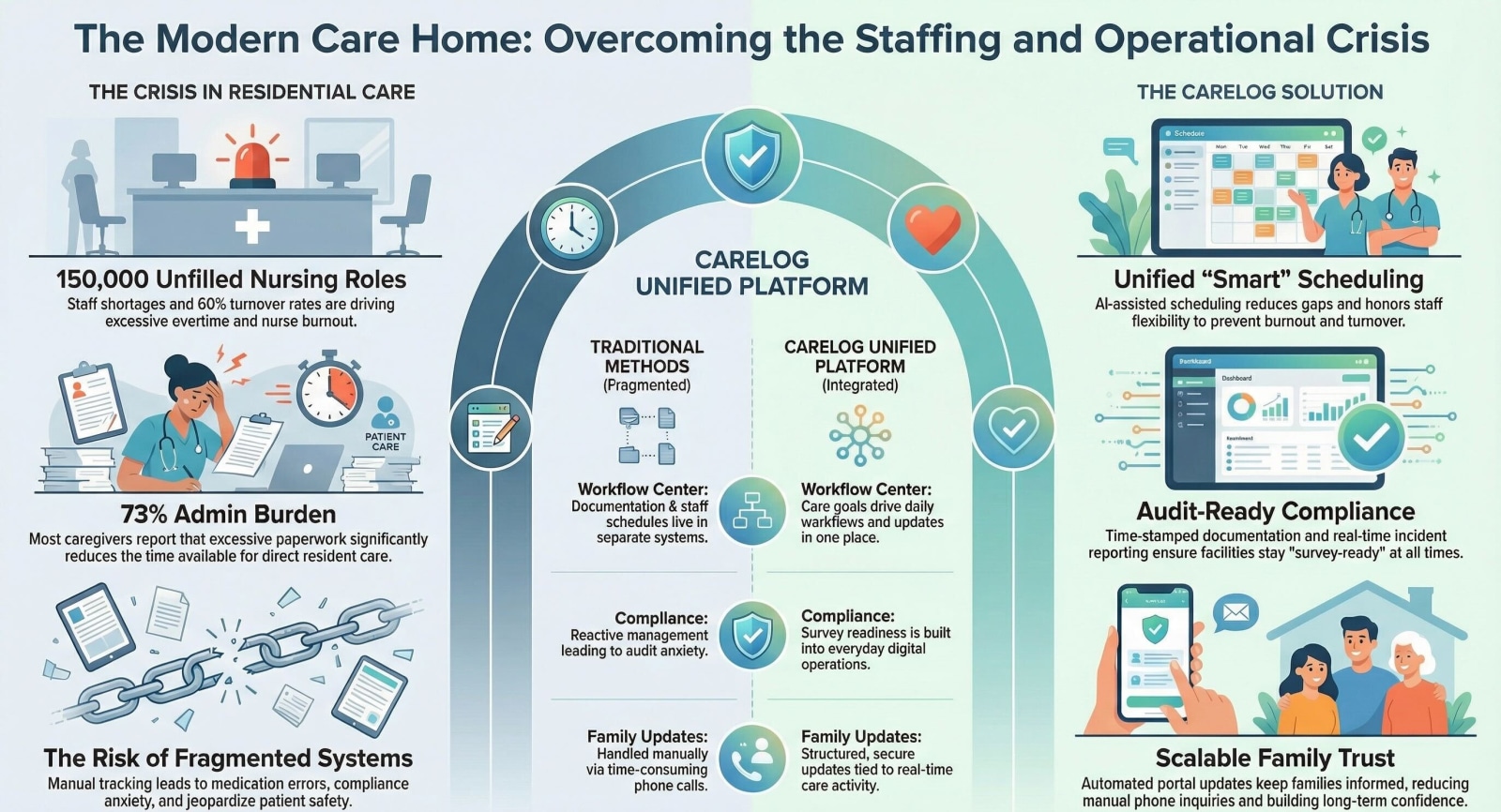
If you are a facility owner or Director of Nursing, you already know the reality. The care is the rewarding part. The operations are the battle.
In 2026, residential care facilities are facing a perfect storm. Acuity levels are rising, regulations are tightening, and the workforce is under more pressure than it has been in years. The US Bureau of Labor Statistics projects demand for long-term care managers to grow 29% between 2023 and 2033, nearly seven times the average job growth rate. Canada is facing the same trajectory. The pressure is not coming. It is already here.
After analyzing the market and speaking with hundreds of residential care leaders across North America, here are the top 10 challenges facing care home owners today and practical ways to solve each one.
1. The Staffing Crisis That Is Actually a Scheduling Crisis
Everyone talks about the shortage of caregivers. But the real issue is often how facilities treat the caregivers they already have. Rigid schedules, unpredictable on-call demands, and lack of flexibility are primary drivers of burnout and resignation. According to the 2025–2026 Nursing Home Salary and Benefits Report, Certified Nursing Assistant (CNA) turnover across North American long-term care facilities remains above 40%, meaning nearly half your frontline staff will leave this year. When staff feel they have control over their schedules and work-life balance, retention improves significantly.
The Fix: Move away from rigid rostering. Offer flexibility where possible. When your schedule works for your staff, your staff will stay.
2. Inadvertent Overtime
One of the biggest silent budget killers in residential care is accidental overtime. A staff member picks up a shift that pushes them into time-and-a-half without management realizing it until payroll runs. Multiply that across a week and you have a budget problem nobody planned for.
The Fix: Use a scheduler with pre-shift alerts. Your system should flag overtime risks before the shift is confirmed, not after the damage is done.
3. Manual Madness in the Command Center
Are you still running your home from a whiteboard in the break room? Paper calendars, sticky notes, and spreadsheets create a single point of failure. If the administrator gets sick, nobody knows who is working tomorrow. This is not just inefficient. It is a risk.
The Fix: Centralize your schedule in the cloud. When a shift changes, everyone knows instantly. No phone trees, no confusion, no Sunday night panic.
4. Survey and Compliance Anxiety
Whether you are navigating state regulations in the US or provincial standards in Canada, compliance anxiety is universal in this industry. If your documentation is scattered across binders or disconnected apps, you are exposed every time a surveyor walks through the door. Inspections do not give you a warm-up lap.
The Fix: Switch to audit-ready documentation. Digital logs should be time-stamped and built around resident care goals so your team is survey-ready every single day, not just the week before an inspection.
5. Medication Errors and Liability
This one carries serious weight. Peer-reviewed research published in the Journal of the American Geriatrics Society found that medication errors affect between 16% and 27% of all nursing home residents, and that 75% of residents are prescribed at least one potentially inappropriate medication. These are not outlier facilities. This is the industry average. Paper MARs, disconnected systems, and rushed med passes are not just inconvenient. They are liability risks.
The Fix: Integrate your MAR directly into your daily care flows. When medication tracking is unified with the rest of your operations, errors become visible before they reach the resident.
6. Managing Acuity and Ratios
Admitting a new resident is great for occupancy. But if that resident requires two-person transfers and you have not adjusted your staffing ratios accordingly, your team will struggle. Understaffing does not just affect morale. It affects your inspection results, your star rating, and ultimately your reputation in the community you serve.
The Fix: Real-time visibility. Your operational tools should show you coverage and ratio compliance instantly so you can adjust before a crisis develops, not after one already has.
7. The Family Communication Loop
Families are anxious, and constant phone inquiries drain staff resources. When families call daily to ask whether Mom took her medications, it pulls nurses away from the residents in front of them. That is not a family problem. That is an information gap problem.
The Fix: Proactive transparency. A Family Portal that automatically shares secure care log updates removes the need for those calls entirely. When families can see real-time updates on their phones, they stop calling and start trusting.
8. Fragmented Systems and App Fatigue
Many facilities are running care logs in one system, scheduling in another, and billing in a third. Staff are juggling multiple logins and duplicating data entry across platforms. This is not just frustrating. It directly contributes to errors, burnout, and staff turnover.
The Fix: Choose an all-in-one platform. When staffing, documentation, and family updates live in one unified system, your team stops wasting time and starts delivering care.
9. Rising Operational Costs
Agency staffing costs are quietly eating into budgets that should be going toward care quality. Research published in Health Affairs found that agency staffing runs 50 to 60% more expensive per hour than directly employed staff. For facilities without scheduling systems that proactively reduce gaps and shift scrambles, that premium becomes a recurring line item that never goes away.
The Fix: Automate the invisible work. Streamlining scheduling, billing, and administrative reporting stops revenue leakage and reduces overhead in ways that compound over time.
10. Administrator Burnout
This is the hidden crisis nobody talks about openly. Owners and administrators across North America are spending the majority of their week on operational firefighting instead of focusing on culture, care quality, and growth. When leadership burns out, everything downstream suffers: staff morale, family trust, and resident outcomes.
The Fix: Buy back your time. By using AI to handle the scheduling puzzle and compliance tracking, CareChart customers report saving 10 or more hours a week. Hours that go back into leadership, not logistics.
Stop the Scramble. Start the System.
At CareLog, we built our platform specifically to solve these 10 problems for residential care homes with 6 to 50 beds across North America. We replace the whiteboard, the binder, and the Sunday night stress with a single intelligent care platform designed for how your facility actually operates.
Ready to see how we do it. Book a demo today.