Care home and assisted living software: 2026 buyer’s guide
What you'll learn
Choosing the right care home management software is one of the most consequential operational decisions a care home operator can make. The landscape has fundamentally shifted. Rising compliance demands, persistent workforce shortages, and families who expect real-time transparency have made disconnected, paper-based operations genuinely unsustainable. Care home management software, once considered an enterprise luxury, is now essential infrastructure for residential care facilities of every size.
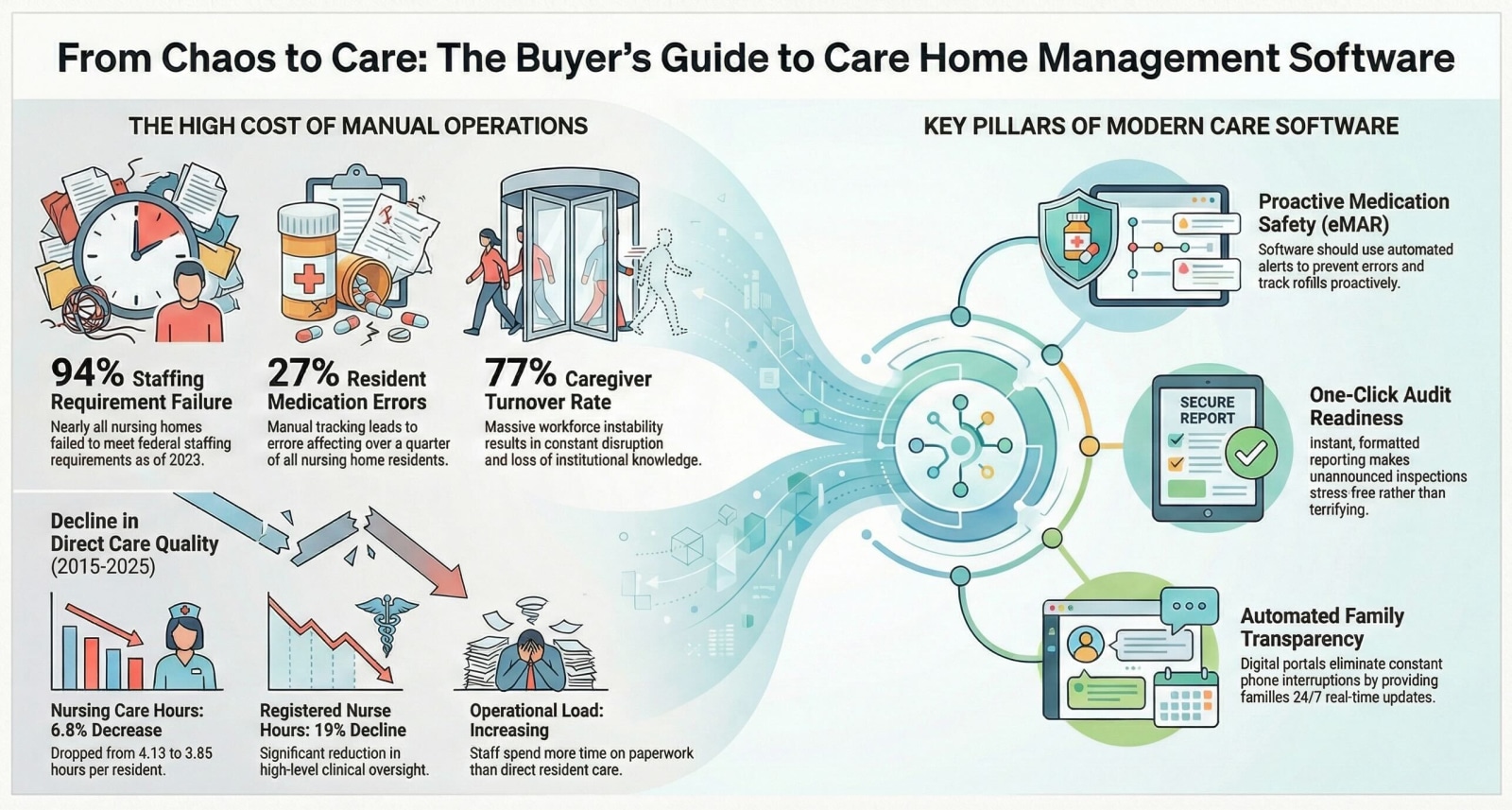
The stakes are real and measurable. A CIHR-funded TREC study of care aides in western Canadian nursing homes found 86% reported being rushed and 75% left at least one care task unfinished per shift, most commonly talking with residents and assisting with mobility. Medication errors affect 16–27% of nursing home residents, with 75% prescribed at least one potentially inappropriate medication. These are the conditions your software needs to address.
Modern facilities require unified platforms with real-time insights and seamless workflows. Paper binders, scattered spreadsheets, and manual tracking no longer suffice. Families now expect digital transparency that traditional phone-call-based communication simply can't provide.
So how do you stay ahead of constant regulatory changes while improving care quality and family satisfaction despite severe workforce constraints? The answer is technology built specifically for how care homes operate, not repurposed hospital software or generic business tools that never quite fit. But selecting the right care home management software is its own challenge: what should it actually look like? Which features genuinely matter versus which are marketing fluff?
The best care home management software empowers you to run complete operations from one unified platform. It offers intuitive care management tools for daily tasks, medications, and incidents. It provides automated family communication that eliminates endless phone calls. It includes built-in compliance tracking that makes audits stress-free instead of terrifying. It features predictable pricing that doesn't punish you for growing. And it's built around how care homes actually operate, not generic healthcare workflows that don't fit your reality.
This guide will help you navigate the care home software landscape with a comprehensive list of capabilities that actually matter, essential questions to ask vendors, discussion points for internal and external stakeholders, and critical mistakes to avoid when evaluating solutions. You'll gain a clear framework for selecting a platform aligned with your current needs and future goals, ensuring a smooth journey without expensive surprises. Let's get started.
Step 1: Defining your care home management software needs
First and foremost, before any Google searches, conversations with peers, or vendor demos, you need to collect internal feedback to understand what your facility and your team actually need. This will help you easily communicate your challenges and requirements to vendors, so you get the most out of your evaluation process.
Here are six critical questions and examples to help you assess your needs and prepare for meaningful discussions. Be creative, dig deep, and raise flags as early as possible to avoid surprises and implementation failures later. This list is not exhaustive, let it inspire thorough internal discovery.
What is the current state of your care home operations?
We use paper charts, binders, and whiteboards for everything
We work with multiple disconnected digital tools that don't communicate
We have care software but it's outdated, clunky, and staff avoid using it
We rely on consultants or external firms to manage our systems
We're opening a new facility and starting fresh
Other: _______________
What are your current operational challenges?
Staff spend more time on documentation than with residents
We can't find critical information during emergencies or inspections
Medication errors happen because tracking is manual
Families constantly call asking for updates we don't have time to provide
We've had audit failures due to incomplete documentation
Scheduling is chaos, constant last-minute coverage scrambles
Medication refills happen reactively instead of proactively
We can't track compliance across multiple jurisdictions
Our current system doesn't work on mobile devices
Information lives in different systems that never communicate
Other: _______________
What capabilities do you need?
Complete care management (tasks, incidents, shift notes, health tracking)
Electronic medication administration records (eMAR) with automated alerts
Staff operations (scheduling, time tracking, shift management)
Family portal with automated updates and secure messaging
Compliance tracking with audit-ready reporting
Financial management (expense tracking, billing, budget monitoring)
Integration with payroll and billing systems
Real-time analytics and reporting dashboards
Mobile access for bedside documentation
Secure staff communication and handoff tools
Other: _______________
Do you have a 3-year, 5-year business plan? What events do you foresee?
We plan to open additional care home locations
We're expanding services (memory care, respite care, specialized programs)
We're facing new regulatory changes in our province/state
We expect continued high staff turnover requiring better onboarding
We're pursuing quality certifications or accreditation
We're expanding across state or provincial boundaries
We need to significantly increase resident capacity
We're planning a merger or acquisition
Other: _______________
Define the logistics:
Who are the stakeholders that must be involved in the buying decision?
Who are the decision-makers and who are the influencers?
What are your timelines?
What is your budget?
Other: _______________
Step 2: 7 key elements to look for in care home management software
Now that you've identified your operational pain points and growth requirements, your next step is choosing the right care home management solution. This can be quite a challenge, especially when meeting expectations of multiple stakeholders including administrators, families, frontline staff, and regulatory bodies.
We've analyzed the care home software landscape, examined what successful facilities prioritize, and identified the essential capabilities that separate platforms transforming operations from those merely digitizing existing problems.
Below are the top seven software capabilities that matter most. These features will serve as valuable guidelines to assist you in selecting the most suitable care home software for your facility.
1 – Complete care management and documentation:
Look for comprehensive care management tools with person-centered care planning that goes beyond generic templates to accommodate individual resident needs, preferences, and specific health conditions. Ensure the software enables real-time bedside documentation through mobile devices so staff can complete daily care tasks, log incidents, record shift notes, and track resident health without touching paper.
This eliminates double-entry, ensures accuracy, gives incoming shifts instant visibility, and provides complete records that are instantly accessible when inspectors arrive. When documentation happens in real-time at the bedside rather than hours later from memory, quality improves across the board, and staff spend their time where it belongs: with residents, not at desks.
2 – Medication management with proactive safeguards:
Look for complete electronic medication administration records (eMAR) with multiple protection layers including drug interaction warnings, allergy cross-checking, refusal tracking, photo verification, and complete audit trails. The game-changer is automated medication refill alerts that warn you days before medications run out, not after, transforming medication management from reactive crisis mode into proactive planning.
Given that medication errors already affect 16–27% of nursing home residents, with 75% prescribed at least one potentially inappropriate medication, a system that merely records what was given isn't enough. The right eMAR doesn't just track medications. It actively prevents errors by catching drug interactions before administration and stopping potentially fatal allergy conflicts before they reach the resident.
3 – Staff operations and workforce management:
Look for intelligent scheduling with drag-and-drop simplicity, skill-based assignment, automatic conflict detection, and quick shift coverage when staff call out. The solution must include built-in time tracking with mobile clock in/out, real-time labor cost visibility, and secure messaging for shift updates, urgent alerts, and structured handoff tools.
Instead of juggling separate systems for scheduling, timekeeping, and communication that never talk to each other, everything lives in one platform where managers see the complete operational picture instantly and labor costs stay visible in real-time. When a shift opens unexpectedly, the right person is identified and notified in seconds, not after a chain of phone calls.
4 – Family portal and automated communication:
Look for a family portal that eliminates constant phone call interruptions by giving families automated weekly updates showing their loved one's activities, meals, mood, and health observations. Families should be able to view care summaries, see photos staff share with consent, send secure messages to the care team, and stay informed 24/7 from any device.
Facilities with robust family portals report dramatically fewer phone interruptions, higher family satisfaction scores, better online reviews, and more referrals, because transparency builds trust. Families now expect digital communication as a competitive necessity, not a luxury. A facility that delivers it earns loyalty; one that doesn't loses it to the one down the street that does.
5 – Compliance tracking and audit readiness:
Look for robust compliance features that maintain regulatory alignment and make audits stress-free instead of terrifying. The system should provide complete audit trails with time and date stamps for all care documentation, incident reports, care plans, and medication records. Every entry, edit, and deletion should be tracked with full version history showing who made changes and when, creating an immutable record that satisfies regulatory requirements across jurisdictions.
Pre-built audit reports should compile all necessary documentation instantly (care goals, progress notes, incident logs, medication administration records, and staff certifications), formatted for inspector review. When an inspector arrives unannounced, you click one button and hand them a complete, properly formatted report: no scrambling, no gaps, no panic. Compliance isn't a nice-to-have feature, it's the foundation your entire operation rests on.
6 – Financial management and operational visibility:
Look for integrated financial management that tracks all resident billing and invoicing and monitors budget spending with real-time visibility. The system should handle invoice generation for families, maintain complete billing histories, and integrate seamlessly with accounting software like QuickBooks to eliminate manual data entry and ensure financial accuracy.
When billing data lives in the same system as care operations, you see the complete picture: resident charges connect directly to services delivered, outstanding balances are always current, and you can track revenue and expenses without switching between multiple platforms or relying on spreadsheets that quickly become outdated. Financial clarity at the operator level starts with operational clarity at the care level, and they need to share the same platform.
7 – Predictable, transparent pricing:
Look for vendors offering flat monthly fees per home location rather than per-resident or per-user pricing. Here's why this matters: per-resident pricing models sound affordable for small facilities but become prohibitively expensive as you grow. Per-user pricing discourages giving system access to the part-time staff and relief workers who need it most.
The right pricing model includes unlimited resident and staff capacity so costs stay predictable as you expand, with everything included. No expensive add-ons for essential features like family portals or compliance reporting. Demand complete transparency about all costs: implementation, training, integrations, ongoing support, and annual increases. If a vendor won't provide clear, upfront pricing and says "it depends on your specific needs," they're hiding costs. Don't invest evaluation time until you have complete pricing clarity.
These seven essential features are indispensable for comprehensive care home management software. The right platform doesn't just digitize your existing processes, it transforms how your facility operates, from reactive firefighting to proactive excellence.
Step 3: Selecting the right care home management software
Features tell you what a platform can do. This step tells you whether a vendor is worth trusting. The process of selecting the right software requires a holistic approach that goes well beyond the feature checklist, because the vendor relationship, implementation quality, and long-term fit are just as consequential as what's on the product roadmap.
Use these five criteria to evaluate any vendor with the same rigor you applied to the feature list:
Long-term value and innovation: The software you select should not only meet your present requirements but evolve to tackle future challenges. Ask vendors directly: what does their product roadmap look like? How frequently do they release updates? What regulatory changes are they already building for? A vendor that can't answer these questions confidently is one that will fall behind as your compliance requirements keep moving forward.
Pricing transparency: Scrutinize not only the initial costs but the full long-term picture: training, support, integrations, data migration, and annual price increases. The sticker price is rarely the real price. Ask for a complete cost breakdown in writing before any contract discussion, and specifically ask what happens to your pricing if you add locations, increase resident capacity, or need additional integrations. Surprises in year two are avoidable if you ask the right questions in year one.
Enablement and support: Software is only as valuable as your team's ability to use it. Select a vendor that offers structured onboarding, role-specific training, and ongoing support that doesn't disappear after go-live. Ask who your dedicated contact will be after implementation, what the typical response time is for support requests, and whether training is included or billed separately.
Customer references and proven results: Go beyond the case studies on the vendor's website. Ask for direct references from facilities similar to yours in size and care model, and actually call them. Ask specifically about the implementation experience, how long it took for staff to genuinely adopt the system, and whether the vendor delivered on what they promised during the sales process. Real operators talking candidly will tell you more than any demo ever will.
Mobile functionality and user experience: Care happens at the bedside, not the office. Your software must work flawlessly on mobile devices in real-world conditions: during a busy morning shift, under time pressure, with limited attention to spare. During your evaluation, insist on testing the mobile experience yourself with actual care tasks, not just watching a polished desktop demo. If staff won't use it because it's clunky or slow on a phone, the investment fails regardless of how impressive the feature list looks.
Discover CareChart
CareChart is the operating system for modern care homes, purpose-built to replace the chaos of disconnected systems with one unified platform that actually works the way care homes operate. Care facilities across North America rely on CareChart to run their entire operations seamlessly, benefiting from real-time documentation, automated medication alerts, built-in family portals, and always audit-ready compliance tools designed specifically for care home operators.
CareChart allows you to consolidate multiple disconnected systems into one centralized platform. Paper charts, scheduling spreadsheets, medication logs, and endless family phone calls are replaced with a complete solution accessible from any device. Your staff can document care in real-time at the bedside, not hours later from memory. Once your operations are unified in CareChart, you can access live reports instantly, automate family updates, and generate audit documentation with a single click.
Most platforms solve one problem. CareChart runs the entire home.
CareChart consists of six integrated modules covering complete care home operations:
Care Management Module: daily care tasks, incident logging with automatic notifications, detailed shift notes for seamless handoffs, and comprehensive resident health tracking.
Medication Tracking Module: complete eMAR with automatic refill alerts that prevent last-minute crises, compliance tracking, and full audit trails.
Staff Operations Module: intelligent shift scheduling, one-tap clock in/out, time tracking, and secure staff communication tools.
Family Portal Module: automated weekly updates families actually read, detailed care summaries with photos, and 24/7 access from anywhere.
Financial Management Module: resident billing, invoice generation, and real-time budget monitoring.
Compliance & Reporting Module: always audit-ready reporting that eliminates compliance anxiety.
CareChart is built for real roles with intuitive workflows tailored to how your team actually works:
Staff can clock in with one tap from their phone, complete care tasks with clear checklists, log incidents quickly when they happen, communicate securely with the team, and access everything from any device.
Administrators can schedule their entire team with AI-powered scheduling generation and drag-and-drop ease, track all medications with automated alerts, review live reports and dashboards anytime, manage finances and track budgets, and stay audit-ready without the stress.
Families can view automated weekly updates about their loved one, see detailed care summaries and photos, and stay informed 24/7 from anywhere.
Predictable pricing that doesn't punish growth.
CareChart uses flat monthly fees per home location, not per resident, not per user. Your costs stay completely predictable as you admit more residents, hire more staff, or expand to new locations. Unlimited residents. Unlimited staff. Everything included. Family portal, compliance reporting, all features, and dedicated support come standard. No expensive add-ons, no hidden charges, no complicated calculations as your home grows.
See CareChart in action.
Schedule a 15-minute walkthrough to see exactly how CareChart runs a complete care home operation. We'll show you real workflows, not theoretical demos. How staff document care in seconds, how medication alerts prevent crises, how families stay informed automatically, and how audit reports generate with one click. There's no obligation. We believe the right software sells itself when you see it in action.
Schedule Your Demo | Visit CareLog
One platform. Total clarity. CareChart eliminates the chaos of disconnected systems and transforms how your care home operates, from reactive firefighting to proactive excellence.