The Growth Tax: Why Care Home Software Pricing Is Broken and What to Do About It
There is a quiet tax embedded in most care home software contracts. It doesn't show up on your state or provincial compliance forms. It isn't imposed by a regulator. It's imposed by the software companies you depend on to run your facility, and it activates the moment you succeed.
We call it the Growth Tax.
How the Growth Tax Works
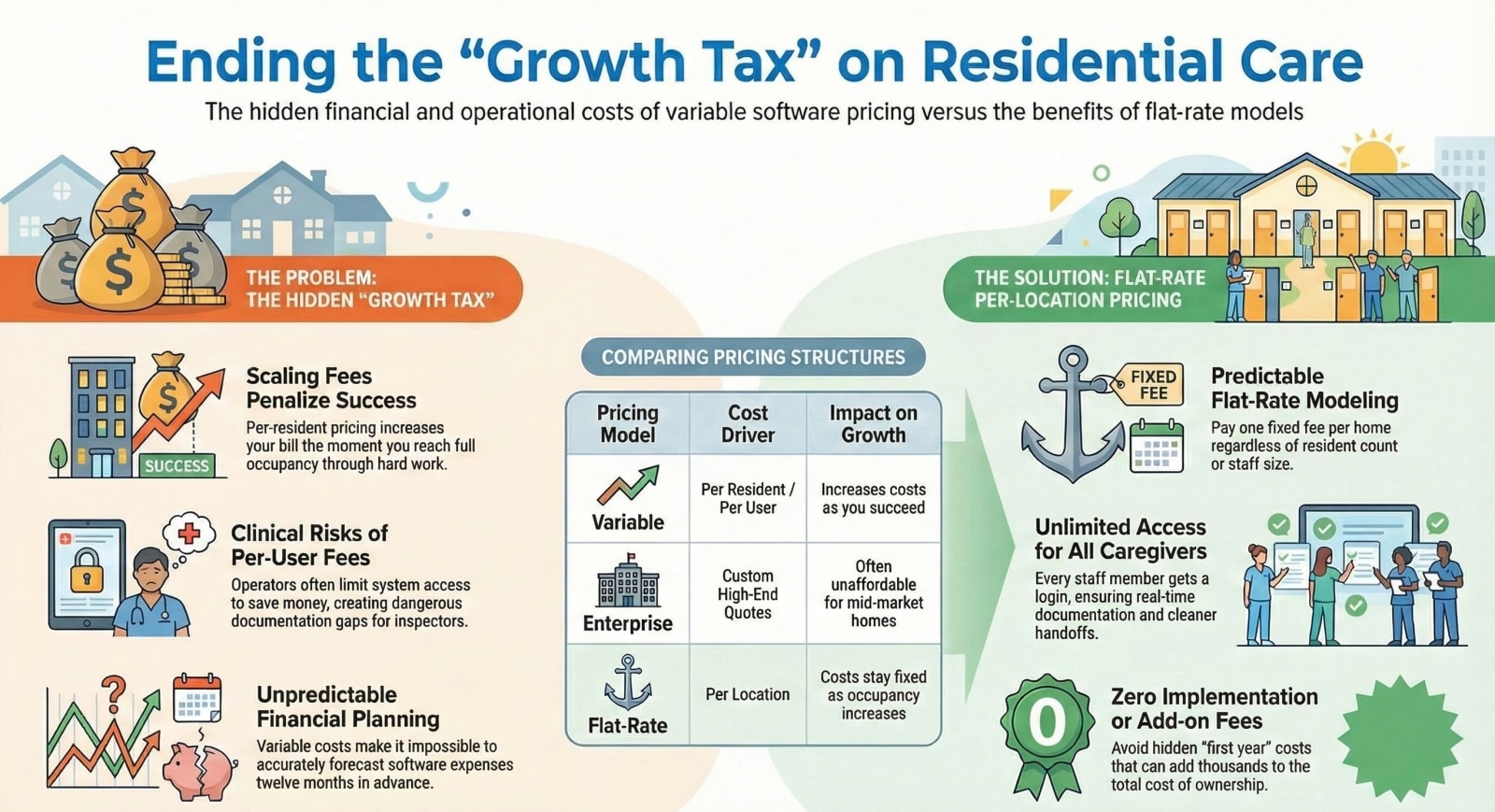
The Growth Tax is per-resident pricing: a model where your monthly software bill scales directly with the number of residents in your care. On the surface, it seems reasonable. You pay for what you use. But look closer, and the logic falls apart quickly.
The cost to a software company of serving your facility does not meaningfully increase when you admit a new resident. Cloud infrastructure is cheap and scales at fractions of a cent. Support load is largely the same. The product doesn't change. What changes is your occupancy, the direct result of your marketing efforts, your staff's hard work, and your facility's reputation.
In other words, per-resident pricing charges you for your own success.
What This Actually Costs You
The math is straightforward, and it's worth walking through with real numbers.
Platforms like ALIS by Medtelligent and Synkwise, two of the more commonly evaluated options in the residential care space, both use per-resident pricing. A home running at 20 residents pays one amount. Fill those same beds to 30 residents, and the bill increases automatically, every month, for as long as you stay full. ECP is another widely used platform in this space. Many platforms across the industry don't publish standardized pricing at all, offering custom quotes instead, which introduces a different challenge: costs that are harder to compare, forecast, or plan around before you've already invested time in an evaluation.
Now run the same scenario on a flat per-location model. Whether you have 20 residents or 30, whether you're at 60% occupancy or 100%, the number on your invoice doesn't change.
For a small residential care operator running on tight margins, that difference isn't academic. It means the difference between a software cost you can plan around twelve months in advance and one that increases every time your occupancy improves. Per-resident pricing isn't designed to hurt you, but it isn't designed with your growth in mind either. Flat pricing is.
Two Taxes, Not One
Per-resident pricing is the most visible version of the Growth Tax, but it isn't the only one. Many platforms also charge per user, meaning every staff member you add to the system increases your monthly bill. ShiftCare, a platform used by Canadian and Australian home care providers, operates on this per-user model. The dynamic is the same: growth costs you more, so operators are quietly incentivized to limit who gets access.
In a care home context, the consequences of restricting user access aren't just financial, they're operational and clinical.
When every login added to the system costs money, the natural response is to limit access to permanent full-time staff. Part-time caregivers, relief workers, and agency staff, the people covering your gaps and often the ones least familiar with individual residents, end up working shifts without access to real-time care notes, medication records, or task lists. They're documenting from memory, or not documenting at all, because the system isn't available to them.
Those are exactly the conditions that produce the documentation gaps inspectors find. And they're produced not by negligence, but by a pricing model that makes complete system access feel like a cost to manage rather than a standard to meet.
The question every operator should ask is simple: can every person who touches a resident's care access the system they need, without it affecting your bill? If the answer is no, the pricing structure is creating a problem your care operations will eventually absorb.
The Goldilocks Problem in Residential Care Software
Both pricing issues, per resident and per user, are symptoms of a larger structural problem that has defined the residential care software market for years, on both sides of the border.
On one end sits enterprise software like PointClickCare and AlayaCare. These are powerful platforms built for large-scale operations, with implementation processes, configuration timelines, and price points designed for organizations with the resources to match. For a growing mid-market operator, that entry point alone puts them out of reach. On the other end sits paper and Excel. They are free and familiar, yet quietly expose your facility to compliance risk, medication errors, and the kind of documentation gaps that become serious problems when an inspector walks through the door.
For the operator running one to five homes with 6 to 50 beds, neither option fits. Enterprise software is overkill and priced accordingly. Paper is a liability. And the variable per-resident and per-user pricing models in the middle tier create a third problem: unpredictability that gets worse the better you do.
This is the Goldilocks trap. Too big, too small, or too expensive to grow into.
A Different Model
The alternative is straightforward: flat pricing per location, regardless of how many residents you serve or how many staff members need access to the system.
This model aligns the software company's incentives with yours. When your costs don't increase as you grow, your software vendor has a genuine interest in helping you fill beds, not in billing you more when you do. Unlimited residents, unlimited staff, everything included. The price you pay on day one is the price you pay when you're running at full capacity, with every caregiver on the system who needs to be there.
It also changes how you think about the software itself. When access isn't rationed by cost, onboarding new staff becomes simpler. Relief workers get logins. Agency caregivers can document in real time. Handoffs are cleaner. The system becomes what it was supposed to be, infrastructure that supports care, rather than a resource you quietly manage to keep costs predictable.
For operators running multiple locations, the math compounds in your favour. Each additional home adds one flat fee, not a calculation based on how full each location is. Growth becomes something you can model financially, not something that generates a surprise line item at the end of the month.
What to Ask Before You Sign
Before committing to any care home software, ask these questions directly and get the answers in writing:
What is my cost at 80% occupancy versus 100% occupancy? If the answer involves a calculation, that's per-resident pricing in practice.
What happens to my bill when I hire more staff? If adding a caregiver to the system costs extra, you have a per-user pricing model, and a built-in incentive to restrict access that will eventually compromise your documentation.
What happens to my bill if I add a second location? Per-location flat pricing should give you a clear, immediate answer.
Is there an implementation fee? Onboarding fees are common across the industry and can add hundreds to thousands of dollars to your real first-year cost. Ask for the exact figure upfront, it belongs in your total cost of ownership calculation.
Are there add-on fees for features like family portals, compliance reporting, or additional modules? The base price rarely includes everything. Ask for a complete list of what isn't included.
What does my pricing look like in year two and year three? Annual price increases are standard across the industry. Know what you're agreeing to before you sign, not after your first renewal.
The Bottom Line
The technology partners you choose should be aligned with your growth, not positioned to extract more revenue from it. Per-resident pricing is a structural misalignment between what software companies charge and what operators actually need: predictable costs that make financial planning possible, regardless of occupancy.
The residential care industry has tolerated this model because the alternatives have historically been limited. That's changing. Flat-rate, per-location pricing exists, it works, and it removes one more source of financial uncertainty from an operation that already has plenty.
When you evaluate software, evaluate the pricing model with the same rigor you apply to the features. Because the best platform in the world doesn't stay the best platform if it becomes unaffordable the moment you succeed.
CareChart is a care home management platform built for residential care facilities across North America. CareChart charges a flat monthly fee per home location – unlimited residents, unlimited staff, no implementation fees, no add-ons. See How it works.