Why Running Your Care Home on Five Different Tools Is Costing You More Than You Think
If you run a small residential care home, there's a good chance your operation runs on several different tools that don't talk to each other. A scheduling app here. A paper or digital medication log there. A spreadsheet for billing. Maybe a separate system for incident reporting or family communication.
Each tool does its job in isolation. The problem is that care doesn't happen in isolation, and when your systems don't connect, the gaps between them become your problem to manage manually, every single day.
The Hidden Cost of Disconnected Systems
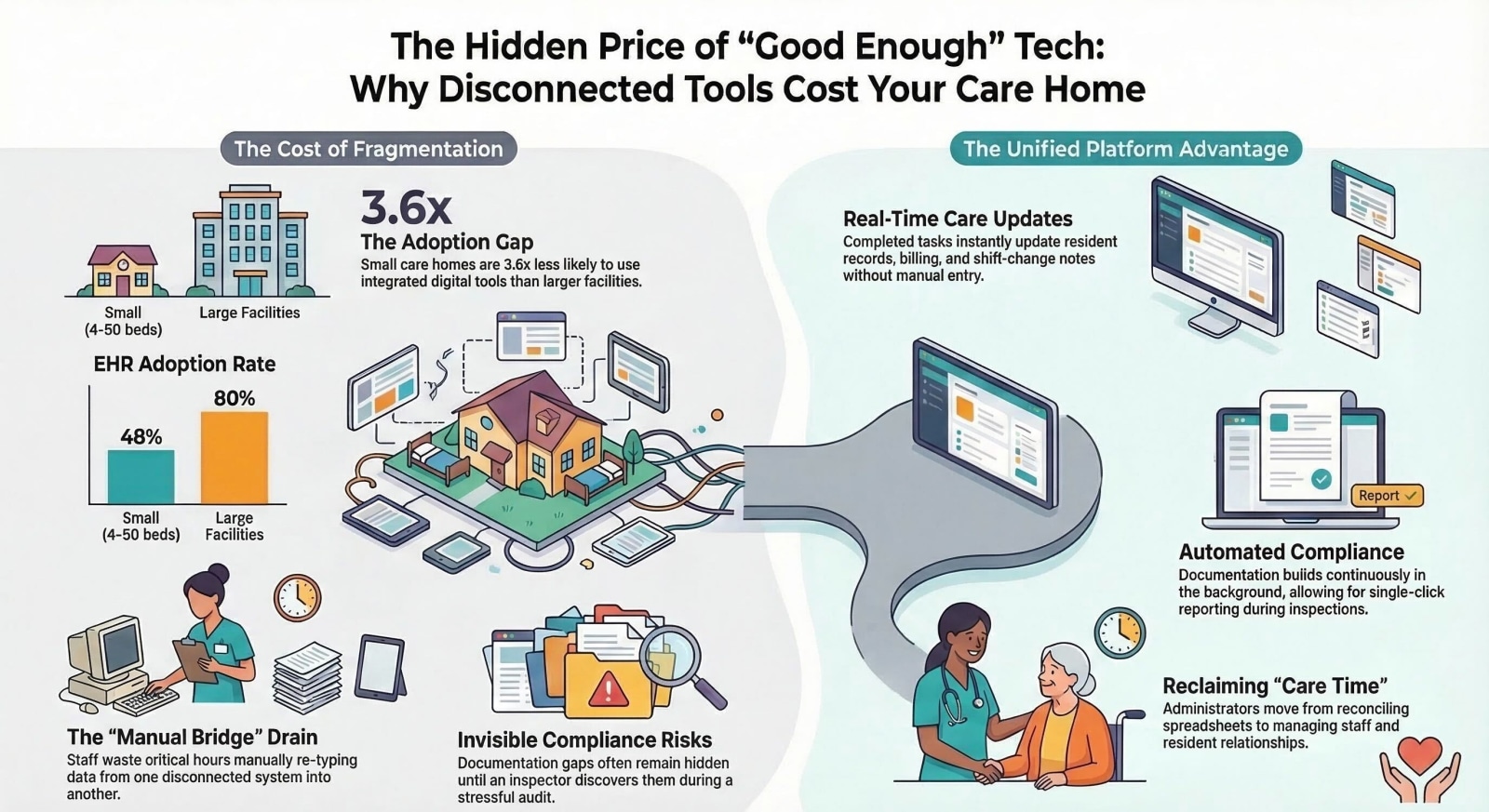
The fragmentation of care home technology is more common than most operators realize. According to CDC data from the National Post-acute and Long-term Care Study, only 48% of small residential care communities with 4 to 50 beds had adopted electronic health records as of 2022, compared to 80% of larger facilities. A peer-reviewed study published in the American Journal of Managed Care found that small and medium communities under 25 beds make up 65% of the assisted living market, yet are 3.6 times less likely to adopt integrated digital tools than their larger counterparts.
This isn't because small operators don't care about technology. It's because the tools available have historically been built for larger organizations: expensive, complex, and hard to justify for a home with 10 or 20 residents. The result is a patchwork approach that feels practical until you look closely at what it actually costs.
When your scheduling system doesn't talk to your care records, a shift change doesn't automatically update who's responsible for which resident tasks. Staff walk into shifts without context. When your medication log lives separately from your incident tracking, connecting a missed dose to a subsequent fall requires manual investigation that takes time nobody has. When billing is disconnected from care documentation, charges get missed and records have to be reconciled by hand at month end.
None of these are catastrophic on their own. Together, they accumulate into hours of administrative time every week, errors that compound quietly over months, and documentation gaps that become visible only when an inspector arrives.
The Manual Bridge Problem
The most expensive thing about disconnected systems isn't the cost of the tools themselves, it's the human time spent bridging them.
Every time a staff member pulls information from one system and types it into another, that's time not spent with residents. Every manual data transfer is a point of potential error. Every report that has to be assembled from multiple sources is a report that takes longer and carries more risk of inconsistency.
For a small operator already stretched thin on staffing, this isn't a minor inefficiency. It's a structural drag on every person in the building. The administrator reconciling billing at the end of the month. The charge nurse cross-referencing the medication log against the care plan. The manager building a compliance report from three different sources the night before an inspection.
These tasks aren't adding care value. They're the cost of running disconnected systems, and they're largely invisible until you calculate how many hours per week they consume.
What Connected Systems Actually Change
When your care tools share a single platform, the dynamic shifts fundamentally.
A care task completed by a caregiver updates the resident's record in real time. The incoming shift sees exactly what happened on the previous one without a phone call or a handwritten note. A medication administered is logged immediately, with a timestamp and staff identifier, visible to anyone who needs it. An incident report filed by one staff member triggers automatic notifications to the right people without anyone having to manually alert them.
Billing reflects what care was actually delivered because the same platform that tracks care tasks generates the charge. Compliance documentation isn't assembled at the last minute because it's been building continuously, in the background, with every interaction logged.
The administrator spends less time reconciling and more time managing. The charge nurse catches a missed medication before it becomes an incident rather than after. The manager walks into an inspection with a single-click report rather than a folder assembled at midnight.
This is the practical difference between fragmented tools and a unified platform. Not a technology philosophy, but a daily operational reality.
Why Small Operators Deserve Better Tools
For too long, the assumption in care home technology has been that sophistication scales with size. Enterprise platforms for large facilities. Paper and disconnected apps for everyone else.
That assumption has real consequences. The same CDC data shows that small residential care communities, the ones serving the most intimate, relationship-driven care, are the least likely to have the digital infrastructure that protects both residents and operators. The documentation gaps, the manual processes, the compliance risks: they fall disproportionately on the operators least equipped to absorb them.
The solution isn't a scaled-down version of enterprise software. It's a platform designed from the ground up for how small care homes actually operate, where the administrator is sometimes also the scheduler, the family liaison, and the person handling compliance. Where every minute of staff time matters. Where a tool that adds complexity is worse than no tool at all.
The Bottom Line
Disconnected systems feel manageable because the costs are distributed across dozens of small moments throughout the day. Nobody sees the full picture until they look for it. But the hours spent manually bridging gaps, the errors introduced in transfer, and the documentation risks created by fragmentation are real, and they compound over time.
A unified platform doesn't just make technology more convenient. It gives your team time back, reduces the conditions that produce errors, and keeps your documentation complete without anyone having to think about it. For a small operator running on tight margins and a lean team, that's not a feature. It's the foundation everything else rests on.
CareChart is a unified care home management platform built for residential care facilities across North America, combining care management, medication tracking, staff scheduling, family communication, and compliance reporting in one system. Flat monthly pricing per location, no implementation fees. See how it works.