Why Senior Care Needs Company Intelligence
Walk the floor of any assisted living community or skilled nursing facility and you will hear the same sounds: call lights, shift handoffs, and — quietly but constantly — staff pulling managers aside to ask the same questions they asked last week.
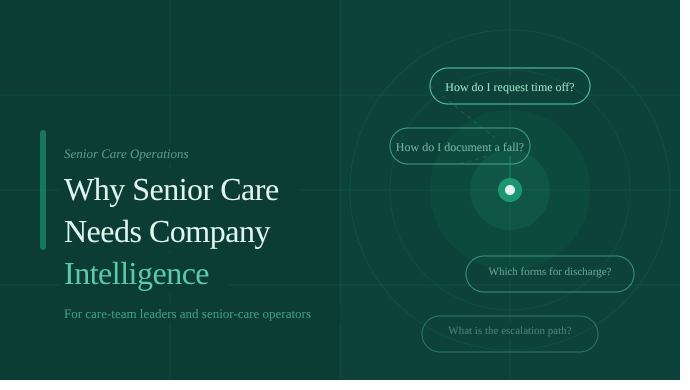
"How do I request time off?" "Where do I find the incident report form?" "What do I do when a resident's condition changes overnight?"
These aren't signs of a disengaged workforce. They're signs of a knowledge problem. And in senior care, that problem is costing more than most operators realize.
"The real bottleneck isn't headcount — it's the invisible tax on every manager's day spent fielding questions that already have answers."
Think about what a typical charge nurse or unit manager fields in a single shift. A new CNA needs to know the protocol for documenting a fall. A med tech wants to confirm the escalation path when a resident shows signs of a change in condition. A scheduler asks — again — which forms are required before a discharge can be processed. Each question takes two or three minutes to answer. Multiply that across a 12-hour shift, and you've consumed a significant slice of your leadership team's day on questions that already have answers somewhere in a binder, a shared drive, or an orientation packet no one can find.
That's not a staffing problem. That's a knowledge-access problem.
Senior care has always been documentation-heavy, and for good reason: compliance, safety, and continuity of care depend on consistent, accurate information. But the way most organizations store and share that information — static PDFs, laminated SOPs taped to break room walls, HR policies buried three clicks deep — was designed for a different era. It assumes staff have time to search, that answers are easy to find, and that everyone received the same onboarding experience. In most communities, none of those assumptions hold.
The result is a fragmented knowledge environment where institutional wisdom lives in the heads of your most experienced employees. When those employees are busy, or when they eventually leave, that knowledge leaves with them. New hires struggle to find their footing. Compliance gaps widen. Managers burn out. And turnover — already one of the industry's most persistent challenges — accelerates.
What the industry needs is not more staff answering the same questions. What it needs is company intelligence for elder care: a structured, staff-only intelligence layer that transforms scattered internal knowledge into instant, consistent, on-demand answers.
The concept is straightforward. Instead of a new hire interrupting a charge nurse to ask about the fall documentation protocol, they ask the intelligence layer. Instead of a manager digging through a policy manual at 11 p.m. to answer an HR question, the answer surfaces immediately. The information was always there — it just wasn't accessible.
Consider how this plays out in practice. Here are four questions staff ask every single day in senior care communities:
Staff question
"How do I request time off?"
Rather than tracking down an HR binder or a manager mid-shift, a company-intelligence layer surfaces the exact request process: which system to use, how far in advance to submit, and who approves it — tailored to that employee's role and location.
Staff question
"How do I document a fall?"
The system walks the staff member through the correct incident report process step by step — which form, what information to include, the required timeframe for completion, and who needs to be notified — consistently, every time.
Staff question
"What's the escalation path for a change of condition?"
Instead of hoping the new hire remembers what was covered in orientation six weeks ago, the intelligence layer surfaces the full escalation protocol on demand: who to notify, in what order, and what documentation is required at each step.
Staff question
"Which forms are required for discharge?"
The correct discharge checklist — current, complete, and specific to the community — is available immediately, reducing the risk of missing a required document and the downstream compliance exposure that comes with it.
New AI-enabled company-intelligence platforms are making this kind of on-demand knowledge access possible at scale. These emerging tools ingest your existing SOPs, HR policies, and internal workflows and make them searchable by staff in plain language. They don't replace your policies — they make your policies findable. And because they're staff-only intelligence layers, the information stays internal, consistent, and current.
The operational implications go well beyond convenience. Faster answers mean shorter onboarding ramps. Consistent answers mean fewer compliance gaps. Fewer interruptions mean managers can spend more time on care and less time as a human FAQ. And when your most experienced employees eventually move on, the institutional knowledge they carried doesn't walk out the door with them.
None of this requires a complete overhaul of how your organization operates. Most communities already have the underlying knowledge — it's sitting in documents, policies, and procedures that staff simply can't access quickly enough when they need it most. The shift is in how that knowledge gets surfaced: not through a search bar and a stack of PDFs, but through a responsive intelligence layer that meets staff where they are, answers their question in context, and gets them back to the work that matters.
Senior care has always required exceptional people. Company intelligence for elder care doesn't replace them — it frees them to focus on what they actually came here to do: care for residents, support their teams, and build communities where both staff and residents can thrive.
Try out our new module which does exactly that